
Affiliate links — we may earn a commission
Last updated: October 2026. Rules and rates checked October 2026 on borger.dk, nyidanmark.dk and the a-kasser’s own websites. Some links are affiliate links, marked as sponsored. You never pay extra.
Quick answer
- An a-kasse (arbejdsløshedskasse) is a Danish unemployment insurance fund. Membership is voluntary. If you are a member and lose your job, it pays you dagpenge (unemployment benefits) and helps you look for work.
- You cannot get dagpenge while you are studying. As a student you join to build up membership time, so you can claim after you graduate.
- Student membership is usually free for up to five years if you meet the fund’s conditions (qualifying education, income ceiling including SU, residence).
- New graduates in 2026 get 15,759 kr a month for the first three months (18,074 kr with children), then less if you have no children. Benefits last one year.
- Membership does not guarantee benefits. You need to pass Danish test PD2 or have 600 working hours, notify your a-kasse within 14 days of graduating, and have a residence basis that allows benefits. Holders of SIRI’s job-seeking permit for graduates are not allowed to receive them.
Already know the basics? Compare fees and pick one in our best a-kasse comparison for 2026.

The video was recorded before the 2026 rates; the rates and rules in the text below are current.
What is an a-kasse in Denmark?
In Danish, a-kasse is short for arbejdsløshedskasse, an unemployment insurance fund. Thanks to it, people in Denmark can receive financial support while they are unemployed. Unlike in many countries, you are not insured automatically: you have to join a fund yourself.
An a-kasse does three things:
- Pays dagpenge if you are a member, unemployed and meet the conditions. The amounts are set by law, so they are the same in every a-kasse.
- Helps you find a job with CV feedback, job-search meetings and courses. This is where the funds differ.
- Checks that you meet the rules while you receive benefits.
An a-kasse is not a union. A union (fagforening) helps with contracts, pay and disputes at work; many a-kasser sell one as an add-on. Read more in your rights as a union student member.
Can students receive dagpenge while studying?
No. Dagpenge are for people who are available for full-time work, and a full-time student is not. This is true whether you are a Danish or an international student, and whether or not your membership is free.
What you can do as a student is join for free and build up membership time. If you have been a member for at least one year when you graduate, you can be covered from the day after you finish your education. Otherwise there is a one-month wait (CA, graduate rules).
Is a-kasse free for students?
Usually, yes, for a maximum of five years across all funds. Typical conditions in 2026:
- An education of at least 18 months.
- Total income no higher than about 319,000 kr a year including SU (319,163 kr at Min A-kasse; 319,162 kr at CA).
- At CA, you must have lived in Denmark right before your studies began. If you moved to Denmark for your degree, ask the fund before you rely on this.
Once you graduate, the free membership ends and you pay the normal fee, which in 2026 is between 514 and 561 kr a month at the funds we compared.
A-kasse rules for international students and graduates
The permit question comes first
SIRI says holders of the three-year job-seeking permit after graduation are not allowed to receive unemployment benefits, and receiving them can lead to the permit being revoked. If you are a non-EU graduate planning to stay on that permit, joining for free does no harm, but it will not pay you dagpenge while you hold it. EU/EEA citizens and people on other permits are in a different position, because the residence basis is what matters. Ask your a-kasse to check your case.
Conditions for graduate benefits (dimittend route)
According to borger.dk and CA, you must:
- Finish a qualifying education of at least 18 months.
- Meet the language or work requirement: pass Prøve i Dansk 2 with at least 02 (or an equivalent Danish test), or have 600 paid working hours (400 if part-time insured) within 12 months of the last 24. An English-taught degree on its own does not count. Our list of apps and websites for learning Danish can help.
- Join or change to graduate status within 14 days of finishing, usually counted from your final grade. This applies to existing student members too, even if you already have a job. Missing it can lose your education-based right to benefits.
- Live in Denmark immediately before starting your education and no later than 14 days after finishing it (CA’s wording of the residence rule).
- Register as unemployed on Jobnet on your first day without work, and be available for full-time work.
The ordinary route (after you have worked)
Outside the graduate route, you need at least one year of membership and an income of at least 286,632 kr within the last three years (full-time insured, 2026), counting at most 23,886 kr per month. Ordinary benefits last up to two years within three years (borger.dk).
How much are unemployment benefits in Denmark in 2026?
Monthly maximums before tax, full-time insured:
| Situation | Per month (2026) |
|---|---|
| Graduate with dependent children, whole period | 18,074 kr |
| Graduate without children, first 3 months | 15,759 kr |
| Graduate without children, 30 or over, after 3 months | 13,690 kr |
| Graduate without children, under 30, after 3 months | 10,838 kr |
| Ordinary maximum rate | 22,041 kr |
| Ordinary maximum with employment supplement, first 3 months | 26,198 kr |
Sources: Ase’s 2026 rate table and CA. The step-down for graduates without children comes after the first three months of benefits (481 benefit hours for full-time members). Turning 30 or becoming a parent moves you to the higher rate. These are maximums, not guaranteed payouts.
A-kasse in Denmark: the “new rules” for graduates
The graduate rules changed on 1 May 2023. For new graduates today that means:
- Benefits last one year (1,924 hours within two years) instead of two.
- Lower rate after three months for graduates without children, with a lower rate for under-30s.
- Danish language or work-hours requirement (PD2 or 600 hours) to qualify on the graduate route.
What you have to do while on dagpenge
All you need to do in return is look for a full-time job and attend meetings with your a-kasse and your local jobcenter. Your job-search activities are recorded on Jobnet, where you log in with MitID (see our essential apps in Denmark).
- Keep your CV on Jobnet up to date and log the jobs you apply for in your job log (joblog).
- Apply for jobs in line with the plan agreed with your a-kasse and jobcenter.
- Attend every meeting you are booked for. Missing meetings can affect your right to unemployment benefits.
- Be in Denmark and able to take a job at one day’s notice. Report holidays in advance; days away without holiday pay are not paid.
Feriedagpenge: paid holiday while unemployed
While on dagpenge you build up feriedagpenge: 2.08 days for every full month of benefits, up to 25 days in a holiday year (1 September to 31 August). You can use them in that holiday year and the following four months. You cannot earn feriedagpenge for a period where you already earn holiday pay from an employer. Sources: borger.dk, Ase.
Yes, looking for work is work and you deserve a vacation from that. At least, according to Denmark 😏.
Which a-kasse is best for students in Denmark?
At the core they are all similar: the benefits are the same. They differ in fees, the fields they focus on, and the career help they offer. I would advise focusing mainly on specialization and member satisfaction. Here are the ones students ask about most; the full side-by-side with 2026 prices is in our a-kasse comparison.
Akademikernes A-kasse
Akademikernes A-kasse (often called AKA or AAK) is for academics and other graduates and has an English section for international professionals. It costs 517 kr a month in 2026 after you graduate and is free for qualifying students.
Min A-kasse
Min A-kasse is open to all fields and has a full English website. It costs 542 kr a month (414 kr for the first month for new graduates).
Ase A-kasse
Ase is open to all fields. Its a-kasse costs 560 kr a month, and you can add its union for 74 kr (currently with 6 months of union free when you join both).

CA A-kasse and A&Til
CA A-kasse suits business, economics and communication students (561 kr) and explains its graduate rules in English. A&Til (formerly FTF-A) is the cheapest open-to-all fund we found at 521 kr and has English pages.
How to apply for an a-kasse in Denmark
- Choose your a-kasse. Some accept everyone, others focus on specific fields. Use our comparison.
- Sign up online on the fund’s website. You will need your CPR number and MitID (see CPR and the other essentials).
- Provide documents if asked, such as proof of enrolment.
- Join at least a year before you graduate, so you can be covered from the day after you finish.
- Already in an a-kasse and want to switch? Join the new one and ask it to transfer you. Do not cancel the old membership yourself.
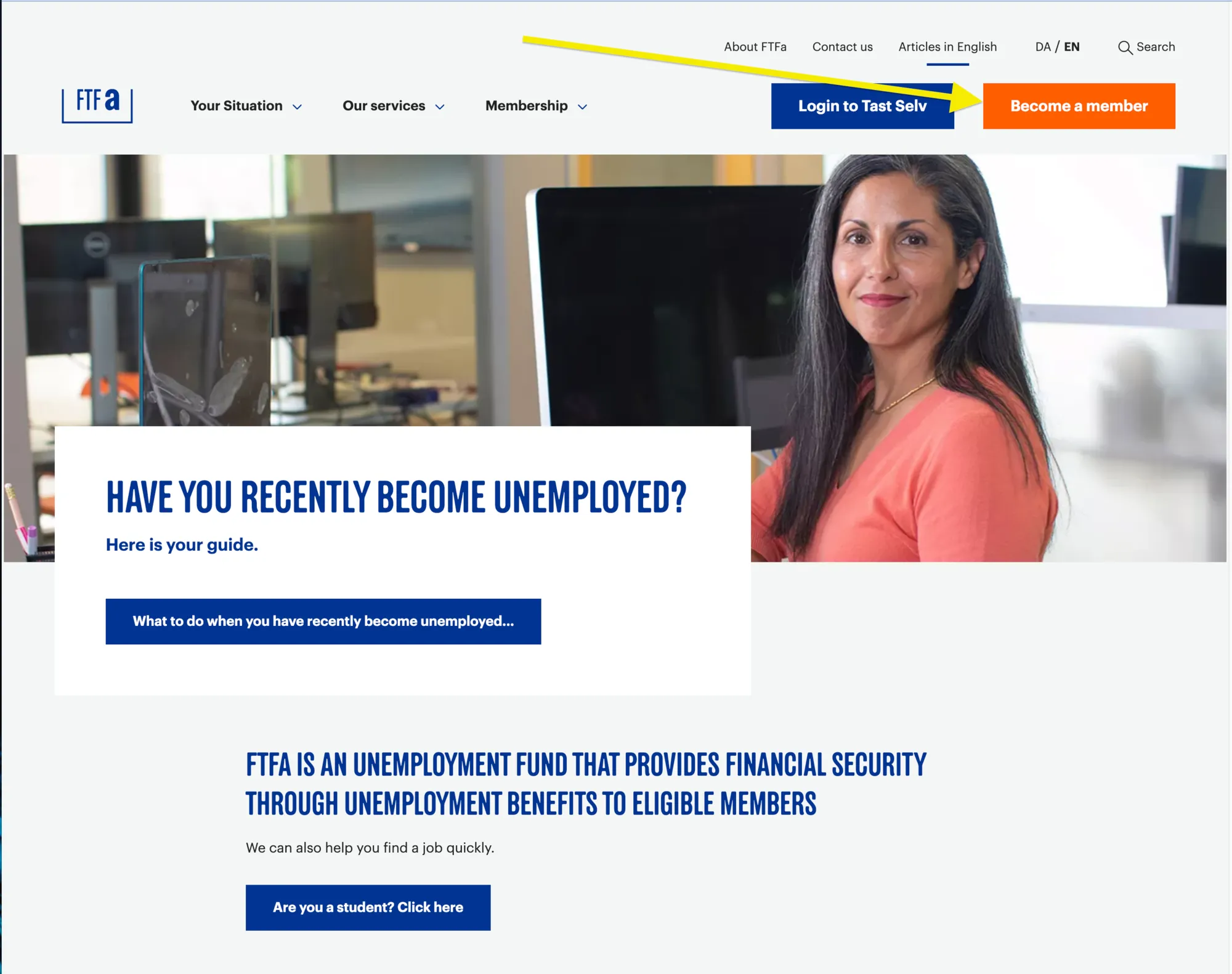
A&Til (formerly FTF-A) has its website in English, making it easier to register.
What to do when you graduate
- Within 14 days of your final grade, tell your a-kasse you have graduated and change from student to graduate status (or join, if you are not a member). Do this even if you already have a job.
- Register as unemployed on Jobnet on your first day without work. Benefits are only paid from the day you are registered.
- Send the forms your a-kasse asks for, and attend the meetings with your a-kasse and the jobcenter.
- Start paying the normal fee, since the free student membership ends.
Just like that, you become a proper job-seeker and hopefully an employee soon. Our guide on finding a job in Denmark as an international has more tips.
Frequently asked questions
Can I get dagpenge as a full-time student in Denmark?
No. You can be a free member while studying, but dagpenge are only paid when you are available for full-time work, which normally means after you graduate.
Can foreigners join an a-kasse in Denmark?
Yes, if you live or work in Denmark. Whether you can receive benefits depends on your residence basis: holders of the post-study job-seeking permit are not allowed to.
What is the a-kasse dagpenge rate for new graduates in 2026?
15,759 kr a month before tax for the first three months, or 18,074 kr with children. After three months, graduates without children get 13,690 kr (30 or over) or 10,838 kr (under 30).
Does the a-kasse membership count while I study?
Yes. Your time as a student member counts toward the one year of membership. Join at least a year before graduating.
What happens if I miss the 14-day deadline?
You can lose the right to benefits based on your education. Then you would need to qualify through work instead.